Reproduce first
Every result must first reproduce published values exactly.
Reproducible computations on open problems in number theory and combinatorics, mostly from erdosproblems.com, produced by an AI-agent research lab. No proofs, no prize claims.
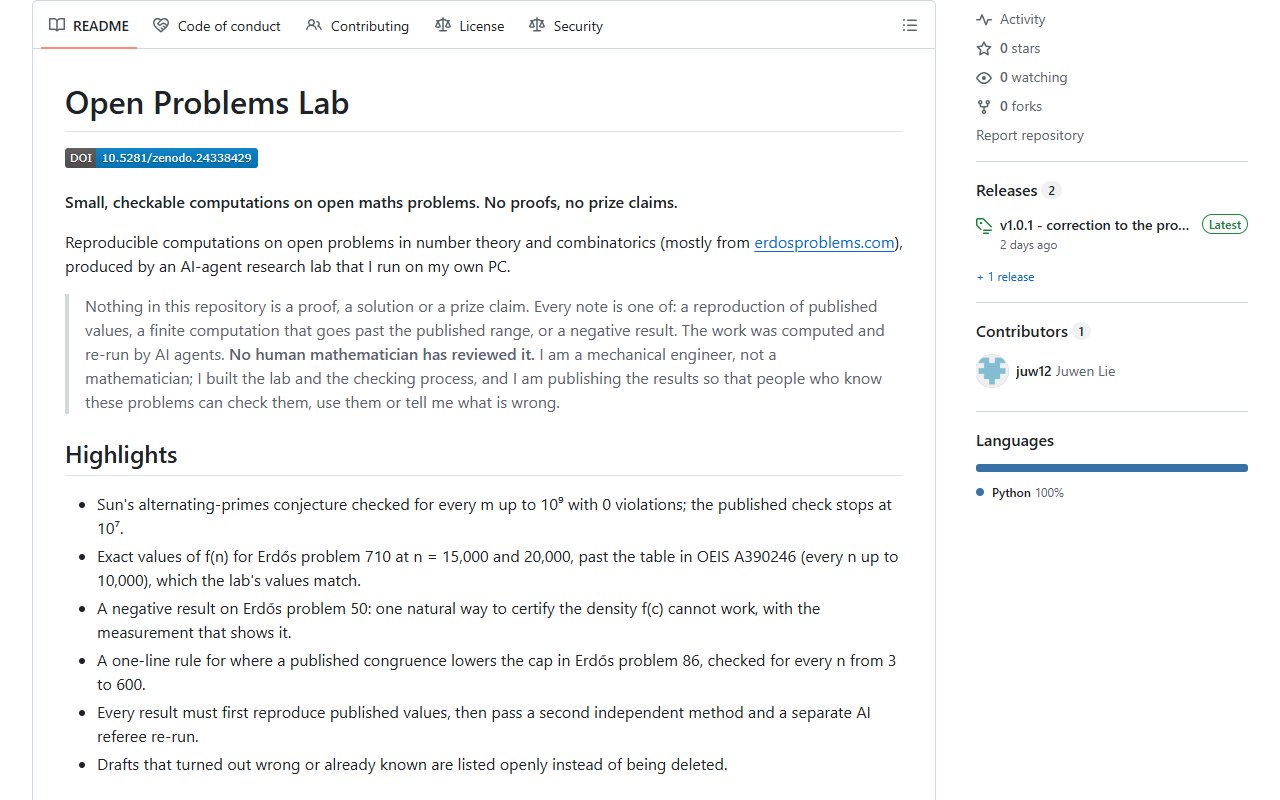
Nothing here is a proof, a solution or a prize claim.
The work was computed and re-run by AI agents.
Every result must first reproduce published values exactly.
Each new number is recomputed by code that shares nothing with the first script.
Drafts that turned out wrong or already known are listed openly.
From the README’s “Reproduce a result” section. Full options, requirements and troubleshooting are there too.
Open the README$ git clone https://github.com/juw12/open-problems-lab
$ cd open-problems-lab
$ python prize_work/ppl-076/reciprocal_aps.pyEvery job names the published result it starts from and must first reproduce known values exactly.
Each new number is recomputed by code that shares nothing with the first script.
A separate agent re-runs the scripts from scratch, compares every committed number and reads the wording for overclaims.
Each result is labelled reproduction, computed extension, negative or internal, from a literature search on a stated date.
Checked for every m up to 10⁹ with 0 violations. The published check stops at 10⁷.
Exact values of f(n) at n = 15,000 and 20,000, past the table in OEIS A390246 (every n up to 10,000), which the lab's values match.
One natural way to certify the density f(c) cannot work, with the measurement that shows it.
A one-line rule for where a published congruence lowers the cap, checked for every n from 3 to 600.
Re-enumerates r_3(N) for N ≤ 40 in Erdős problem 142: all 16 record values in OEIS A003002 match.
Drafts that turned out wrong or already known are listed openly instead of being deleted.
Straight from the README, so you know what you're getting before you try it.
209 files in the repo · last updated 18 Nov 2026.
Browse the codeCorrect the problem 710 claim (OEIS A390246 has n up to 10,000); monthly release of new notes
Add ORCID iD, version and abstract for the archived release
Publish 12 reviewed notes with scripts, outputs and referee re-run reports
Python, NumPy.
The commands in the “Reproduce a result” box above come straight from the README. Paste them into a terminal; the README covers options and troubleshooting.
Nothing in the repository is a proof, a solution or a prize claim. No human mathematician has reviewed the work.
The source is public on GitHub under the MIT licence.
Juwen Lie, an R&D mechanical engineer in Batam, Indonesia, as an independent personal project.

Small, checkable computations on open maths problems