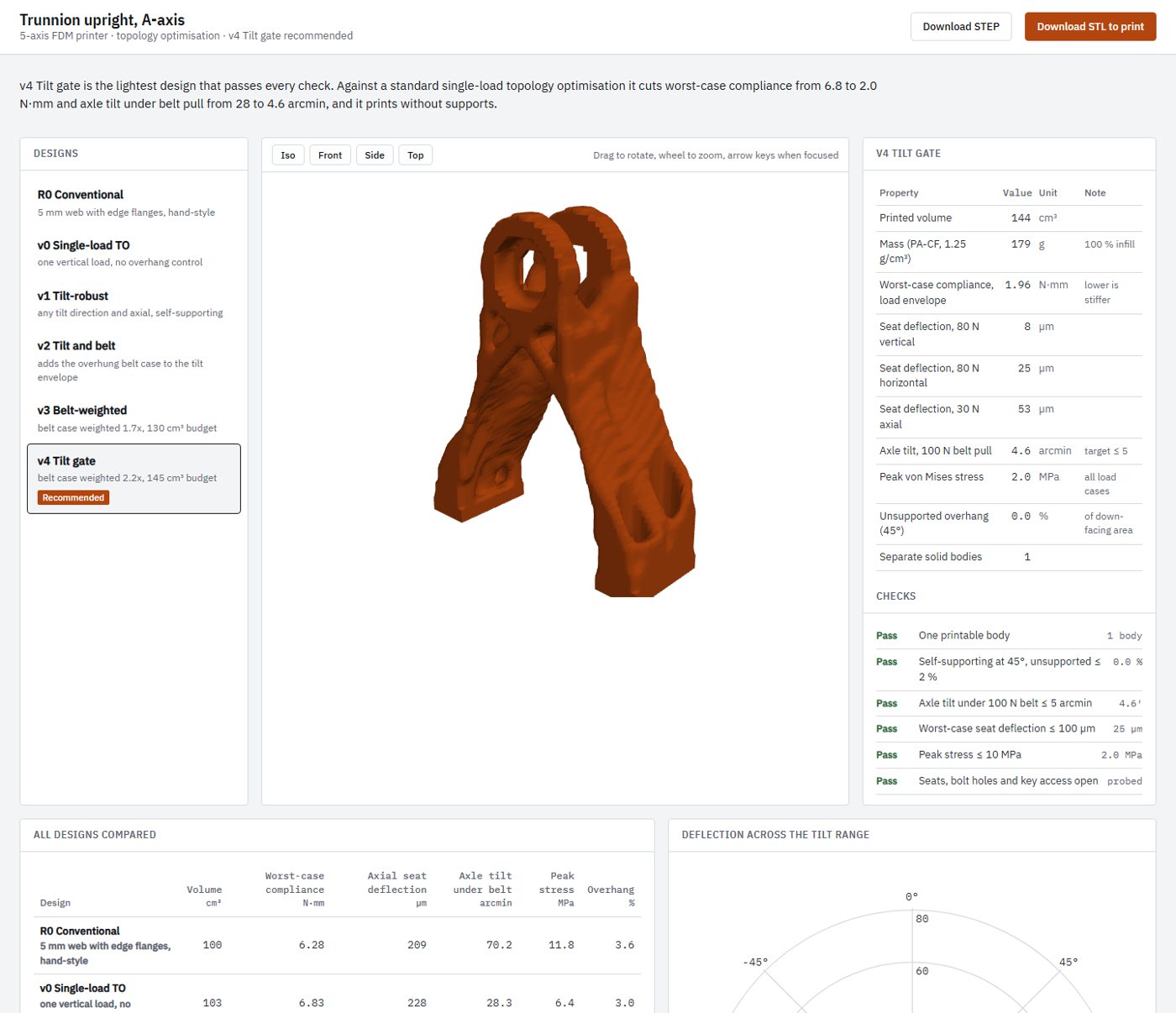
Any tilt direction
A p-norm over the eigenvalues of the load-envelope compliance matrix covers 80 N in every tilt-plane direction plus 30 N axial.
Topology-optimised A-axis trunnion upright: stiff for loads in any tilt direction and for belt pull, prints with no supports, checked by fine-mesh FE.
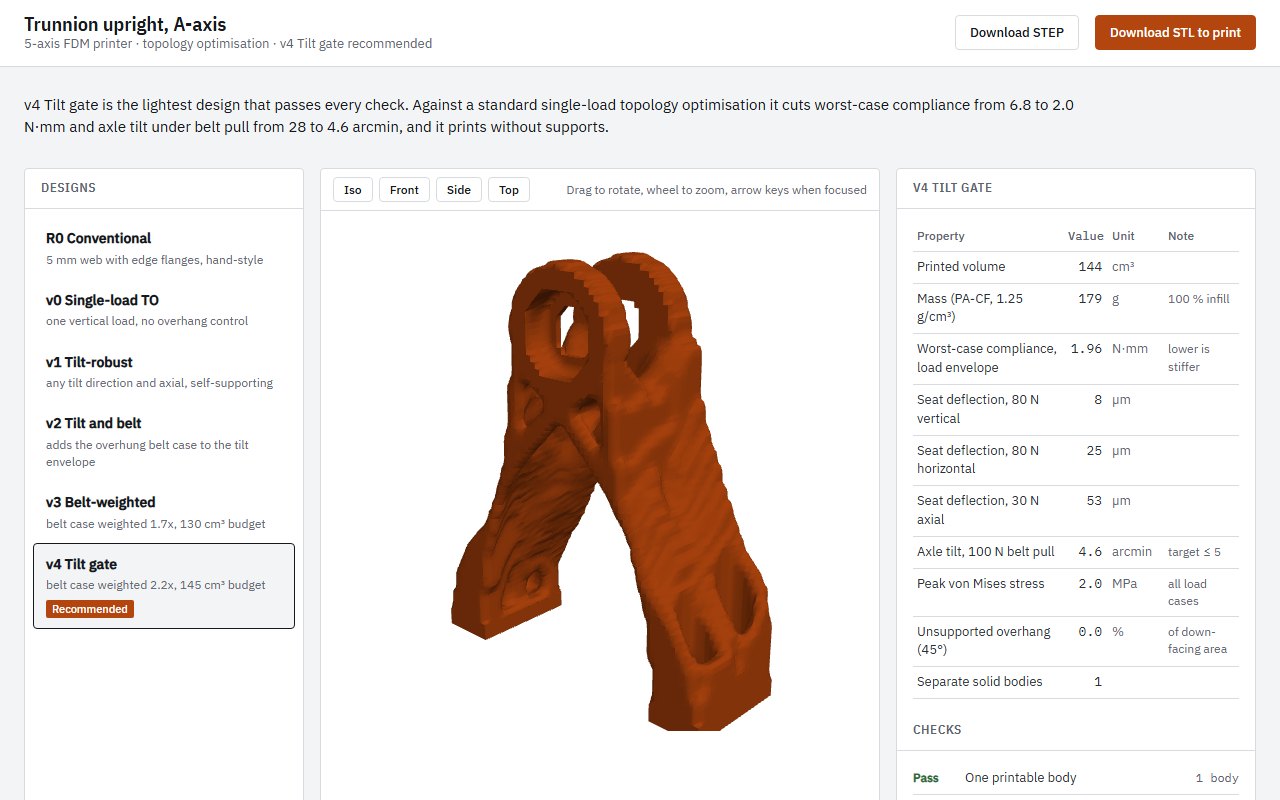
On an AC-trunnion 5-axis printer the bed tilts, so the load on each trunnion upright turns with the A axis.
Trunnion TopOpt optimises the A-axis upright for 80 N in any direction of the tilt plane plus 30 N along the axle, and for a 100 N belt pull on a pulley 15 mm outboard of the outer bearing.
Rotate the 3D view, compare the designs and read the six pass/fail checks.
trunnion_upright_v4_final.stl is watertight and one body.
Ream the 28 mm bearing seats to H7 for the press fit, then check stiffness with a test print.
A p-norm over the eigenvalues of the load-envelope compliance matrix covers 80 N in every tilt-plane direction plus 30 N axial.
100 N on a pulley 15 mm outboard, in any direction. v4 tilts the axle 4.6 arcmin, inside the 5 arcmin target.
A 45° additive-manufacturing filter keeps unsupported overhang at 0.0 % for the build direction +Z.
Two 6001-2RS seats, a 16 mm bore, four M5 holes and hex-key access columns, rebuilt as a single valid STEP solid.
Independent FE at 1.25 mm agrees with the 2.5 mm mesh within about 3 %.
A hand-style baseline, a single-load optimisation and four improvements, each with the same checks.
Straight from the README, so you know what you're getting before you try it.
38 files in the repo · last updated 8 Nov 2026.
Browse the codePython, FEA, CadQuery. You can try it in the browser with nothing to install.
Open the results page: Rotate the 3D view, compare the designs and read the six pass/fail checks.
A checked computer model, not a tested part. Material treated as isotropic (PA-CF or PETG-CF, E = 3.0 GPa, 100 % infill).
Not yet: it's marked “live” and still changing. The README always has the current state.
The source is public on GitHub under the MIT licence.
Juwen Lie, an R&D mechanical engineer in Batam, Indonesia, as an independent personal project.
A 5-axis printer part optimised for every tilt angle