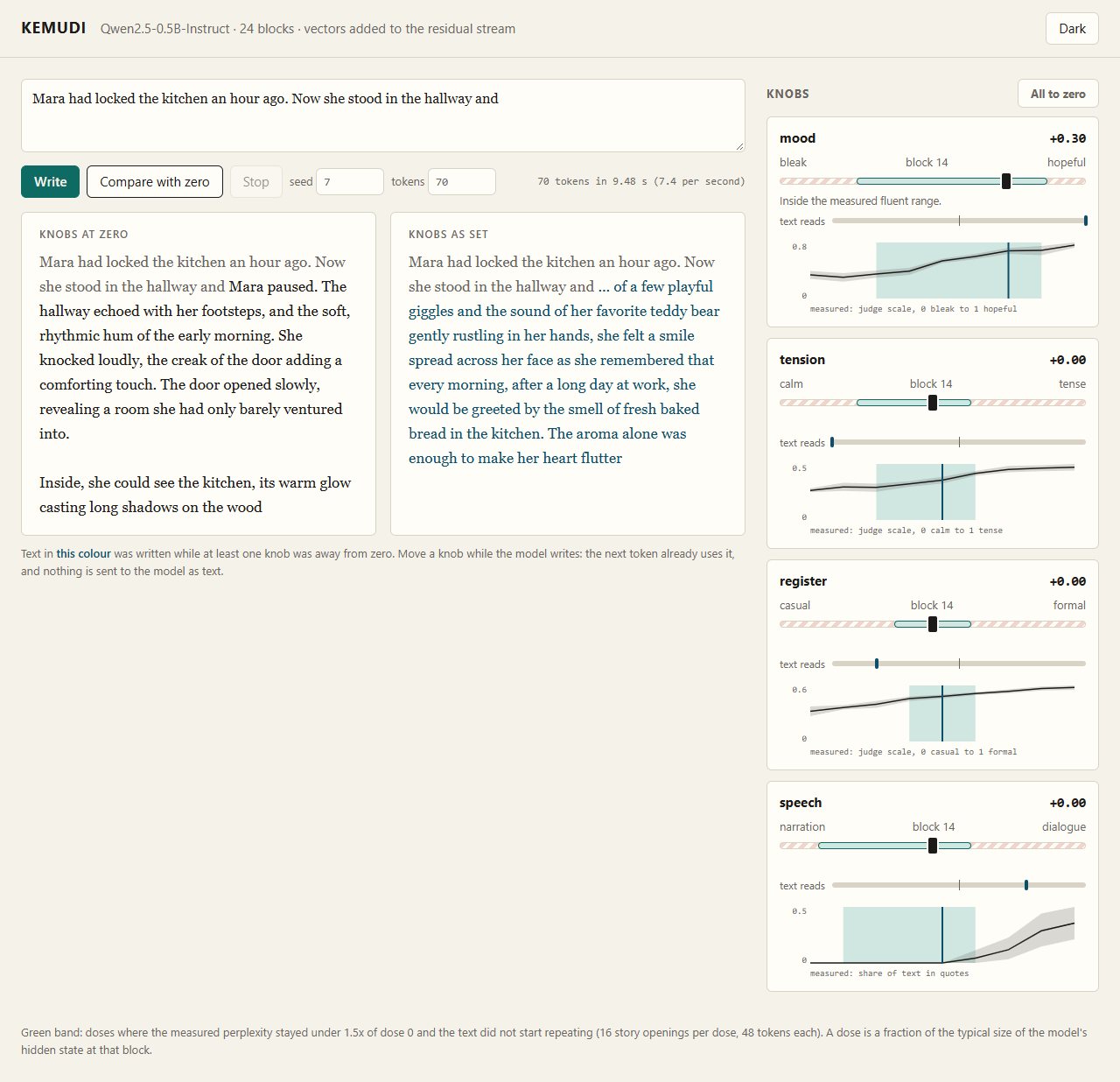
Four knobs
Mood (bleak to hopeful), tension (calm to tense), register (casual to formal) and speech (narration to dialogue), for a story the model is writing.
Each knob adds a direction to the model's internal state while it writes, with no instruction in the prompt. Each one ships with a measurement of what it does to the text and the dose at which the text breaks.
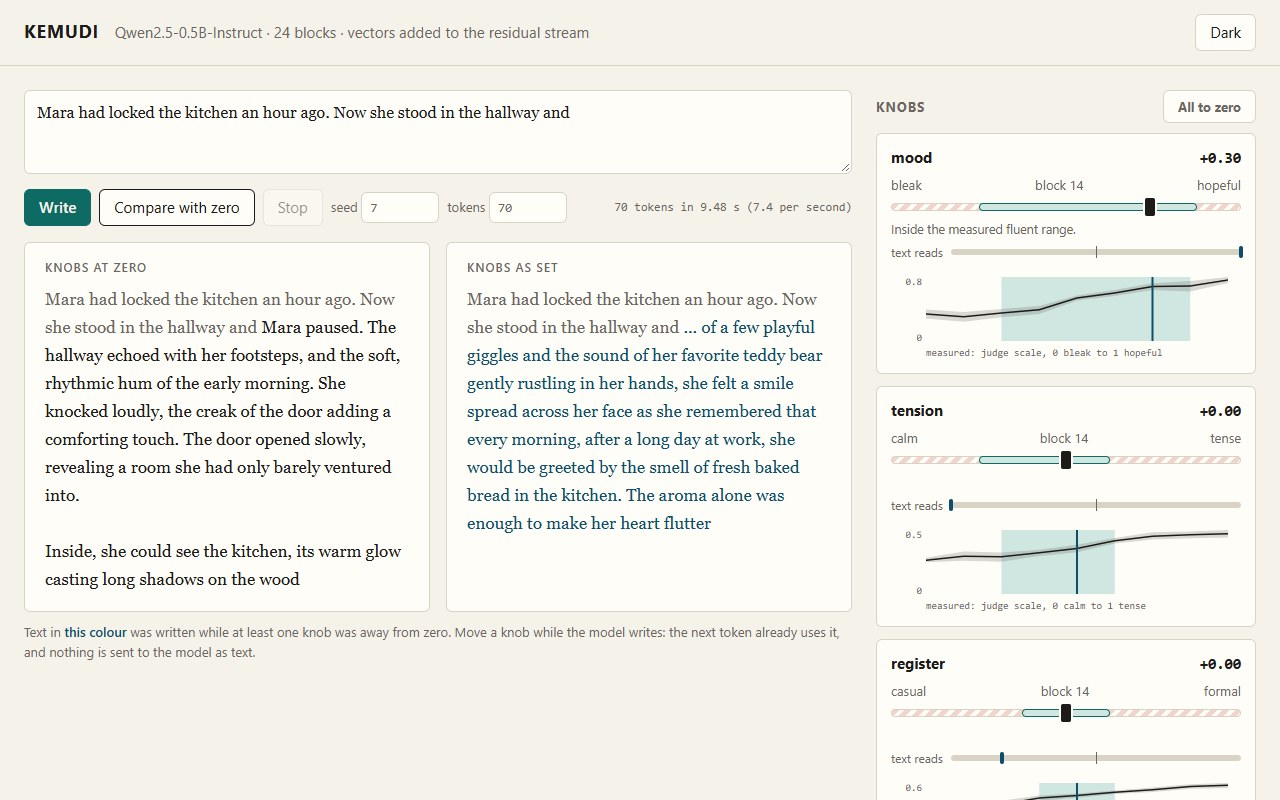
Kemudi gives a small local language model four steering knobs for a story it is writing: mood, tension, register and speech.
Every knob ships with a measurement: sixteen story openings, nine doses, the same random seed, a random-direction control and a prompt control.
From the README’s “Start it” section. Full options, requirements and troubleshooting are there too.
Open the README$ git clone https://github.com/juw12/kemudi && cd kemudi
# Windows: double-click "Start Kemudi.cmd" macOS or Linux: ./start-kemudi.sh
# or by hand, with Python 3.10 or newer:
$ pip install torch --index-url https://download.pytorch.org/whl/cpu
$ pip install -e .
$ kemudi serve --openSixteen story openings are each written under two opposite style instructions.
Each knob has 32 hand-written sentences.
While the model writes, a hook adds the vector to the output of that block.
The effect, the perplexity and the repetition of every text are computed by the same model with all knobs at zero.
Mood (bleak to hopeful), tension (calm to tense), register (casual to formal) and speech (narration to dialogue), for a story the model is writing.
Move a slider and the next words change. Nothing is added to the prompt and nothing is regenerated.
The doses that were measured to keep the text fluent. Past the band the app warns you before you get there.
It reads the model's own state along that direction, word by word.
The same opening and the same random seed, written with and without your knobs, side by side.
Each knob has a dose-response with 95% intervals, a random direction of the same size, and a prompt control measured the same way.
The model is Qwen2.5-0.5B-Instruct (about 1 GB, Apache-2.0), on the CPU. No account, no API key, no data leaves the machine.
Straight from the README, so you know what you're getting before you try it.
44 files in the repo · last updated 17 Nov 2026.
Browse the codeOne command to reproduce, a dose table with intervals, a start script for macOS and Linux
Keep line endings stable: LF everywhere, CRLF for the Windows start script
Measured steering knobs for a local language model
Python, local model.
The commands in the “Start it” box above come straight from the README. Paste them into a terminal; the README covers options and troubleshooting.
The model runs on your CPU. The first start installs Python packages and downloads the model once, about 1.3 GB together.
No. Spaceship is an interface study: its knobs are written into the prompt and it calls hosted models.
No. The prompt control failed on this 0.5B model because many of its texts are the control instruction handed back.
Python 3.10 or newer. The first start downloads Python packages and the model once, about 1.3 GB together.
Everything here was measured on Qwen2.5-0.5B-Instruct. The sample is small: 16 openings, 48 tokens each, one random seed, English, story continuation only.
The source is public on GitHub under the MIT licence.
Steering knobs for a local language model.