One presenter, one format
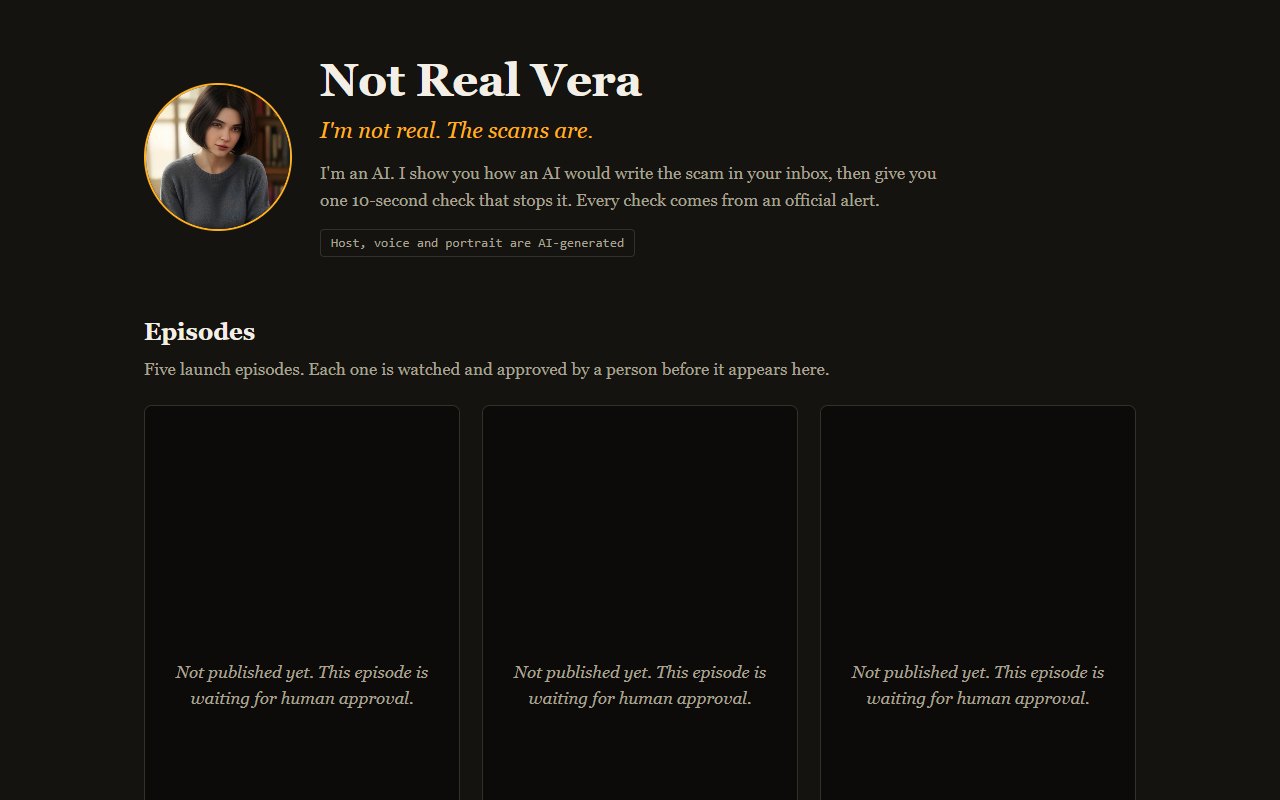
Vera presents every episode the same way: the scam, how it is built to work on you, then the check.
A short-video channel about scam and deepfake defence with one on-camera presenter, Vera. Each 35-45 second episode shows one scam and one 10-second check that stops it.
The repo holds the whole channel as files: the niche research, the channel rules, five scripted episodes, the video renderer and the Buffer scheduling tool.
Nothing has been posted. The episodes are rendered locally and wait for a human to watch and approve them.
Vera presents every episode the same way: the scam, how it is built to work on you, then the check.
Each episode shows one scam and one 10-second check that stops it. No list of ten tips.
Each check is traced to an FBI IC3 alert that was opened and read. The source is on screen and in the caption.
Run make_episode.py for one episode or all five.
Watch the video, then run autopost.py approve for that episode.
autopost.py publish copies approved episodes to media/ and pushes, so Buffer can fetch them.
autopost.py post prints the request as a dry run.
A fake toll text, a cloned voice of your kid, a wrong-number text that turns into crypto advice, a fake deputy on the phone, and what to do when money has already left your account. Each has a script, an on-screen card, a check, a source, a caption and hashtags.
One command turns a script into a 1080x1920 video with voice, captions and sound cues. The voice runs locally with Kokoro.
The posting tool schedules approved episodes through Buffer. Without --live it prints the exact request and sends nothing.
Unapproved episodes are never published or scheduled, and an episode is never scheduled twice.
Posts are sent with each platform's own AI-content label switched on, on YouTube, Instagram and TikTok. Nothing is added to the video or the caption.
A gate script checks the scripts and the renders, including that every source link answers.
An evidence table, a scoring matrix, and the 30-day test that decides if the channel works. The matrix is a judgement, not a measurement.
From the README’s “Make the videos” section. Full options, requirements and troubleshooting are there too.
Open the README$ pip install requests pillow numpy opencv-python imageio-ffmpeg kokoro-onnx
$ python tools/get_voice_model.py # one-time, 120 MB voice model into models/
$ python pipeline/make_episode.py ep01 # or: all
$ python tools/gates.py --links # nine checksStraight from the README, so you know what you're getting before you try it.
30 files in the repo · last updated 14 Nov 2026.
Browse the codeThe commands in the “Make the videos” box above come straight from the README. Paste them into a terminal; the README covers options and troubleshooting.
The Buffer API key is read from ~/.notrealvera/buffer_key.txt or the BUFFER_API_KEY environment variable. Vera never uses a real person's face, voice or name.
The rendered episodes show Vera as a still portrait with camera movement. One synthetic voice plays every part, so the performed scam calls do not change voice.
Not yet: it's marked “in progress” and still changing. The README always has the current state.
Juwen Lie, an R&D mechanical engineer in Batam, Indonesia, as an independent personal project.
Ten seconds. Check first.