Two-question check-in
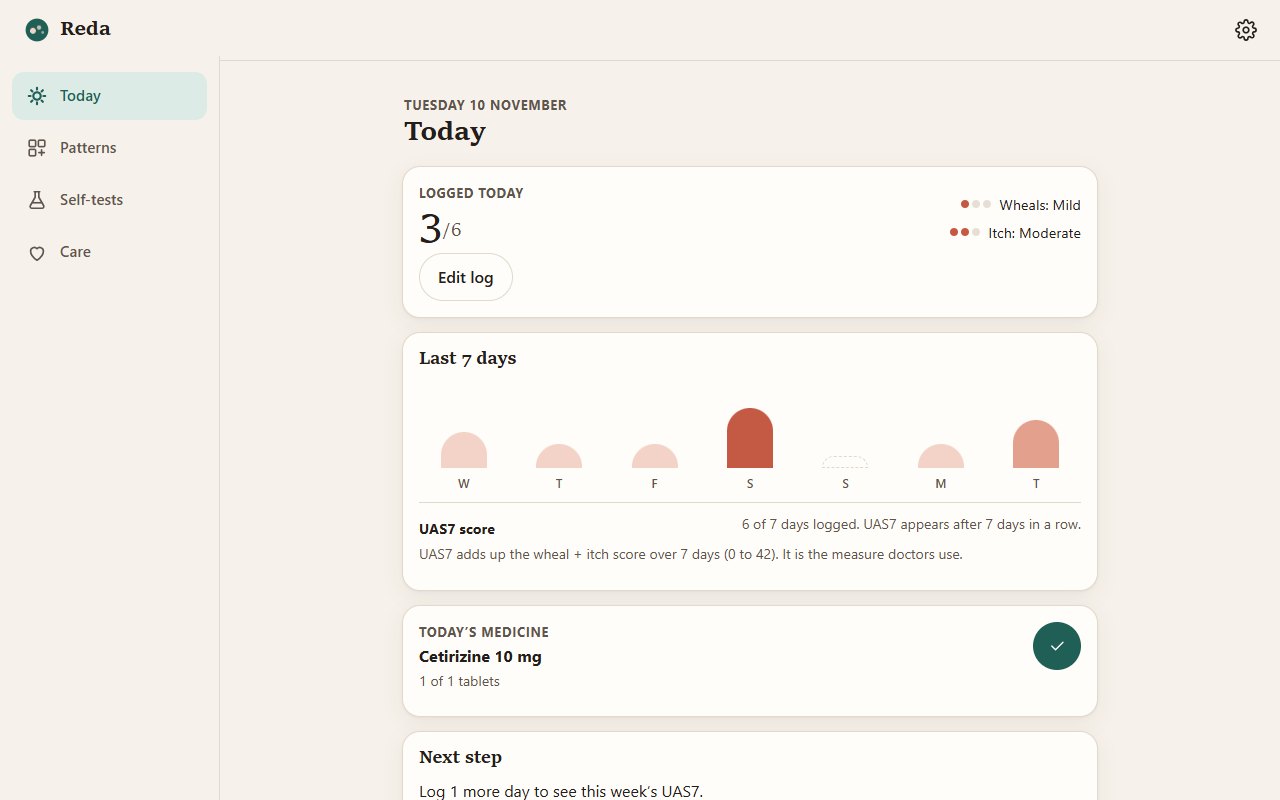
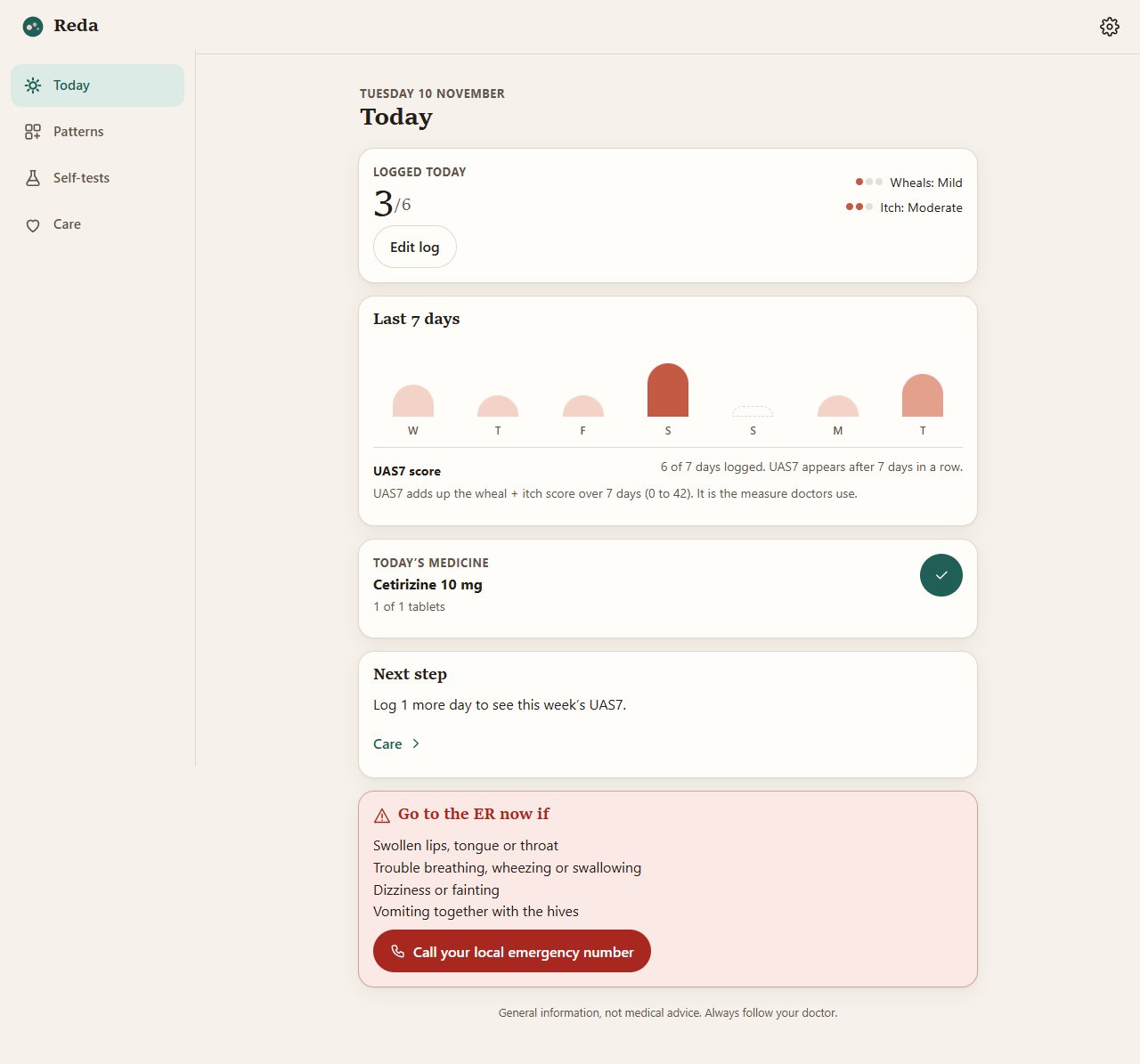
Rate wheals and itch from 0 to 3 each day. Reda adds them into the UAS7 score doctors use, with its band (0 / 1–6 / 7–15 / 16–27 / 28–42).
Log hives in 30 seconds a day, find what sets them off, test your skin at home with photo guides, and keep a medicine plan that follows the international guideline.
In about half of people with chronic hives no trigger is ever found, and allergy tests are often negative.
What helps is measuring the disease the way doctors do, spotting real patterns instead of guessing, checking for physical triggers, and taking a non-drowsy antihistamine every day, stepping up with a doctor when it is not enough.
Open Today and answer two questions: how many wheals, how itchy.
Mark today's antihistamine and anything that happened, such as a food, heat, stress or a painkiller.
After a week, read your UAS7 and the trigger finder on Patterns.
Run a self-test if you suspect a physical trigger, then print the report for your doctor.
Rate wheals and itch from 0 to 3 each day. Reda adds them into the UAS7 score doctors use, with its band (0 / 1–6 / 7–15 / 16–27 / 28–42).
A 7-day ribbon on Today, a weekly UAS7 trend and a 28-day calendar so flares are easy to see.
Compares your score on days with and without each factor, same day and next day for foods. It only says "possible trigger" with at least 3 days on each side and a gap of 1 point or more.
Scratch, ice cube, bag strap, warm glass, exercise and sunlight: step-by-step instructions, built-in timers, reference photos of a positive result and a result log.
A photo gallery that includes angioedema warning signs, and red-flag symptoms with a one-tap emergency call.
Your antihistamine plan with standard adult doses, the guideline treatment ladder with "you are here", and weekly advice: log more, controlled, wait 2–4 weeks, or ask about the next step.
Plain lists of triggers to avoid, comfort measures, and what not to do (long-term steroids, "racikan", CTM), plus tests and questions to bring to the doctor.
Four weeks of UAS7, average score, swelling days, plan, possible triggers and self-test results. Print, save as PDF, copy a summary or export CSV.
From the README’s “Run locally” section. Full options, requirements and troubleshooting are there too.
Open the README$ python -m http.server 8000 # then open http://localhost:8000/?demo=1
$ python tests/run_tests.py # 52 checks: logic, flows, layout gates (needs playwright)Straight from the README, so you know what you're getting before you try it.
61 files in the repo · last updated 10 Nov 2026.
Browse the codeWeb, PWA. You can try it in the browser with nothing to install.
The commands in the “Run locally” box above come straight from the README. Paste them into a terminal; the README covers options and troubleshooting.
N o
The international EAACI/GA²LEN/EuroGuiDerm/APAAACI urticaria guideline (Allergy 2022), the BAD chronic urticaria guideline 2021 and a primary-care urticaria pathway (Clin Transl Allergy 2022).
Wikimedia Commons, under PD, CC0, CC BY or CC BY-SA licences, with full credits on the Settings screen.
Yes. The demo link loads 35 days of sample data so every screen has something to show.
R e
Not yet: it's marked “live” and still changing. The README always has the current state.
A calm companion for chronic hives