Free, in your browser
One HTML file. Nothing to install, no sign-up, and your numbers never leave the page.
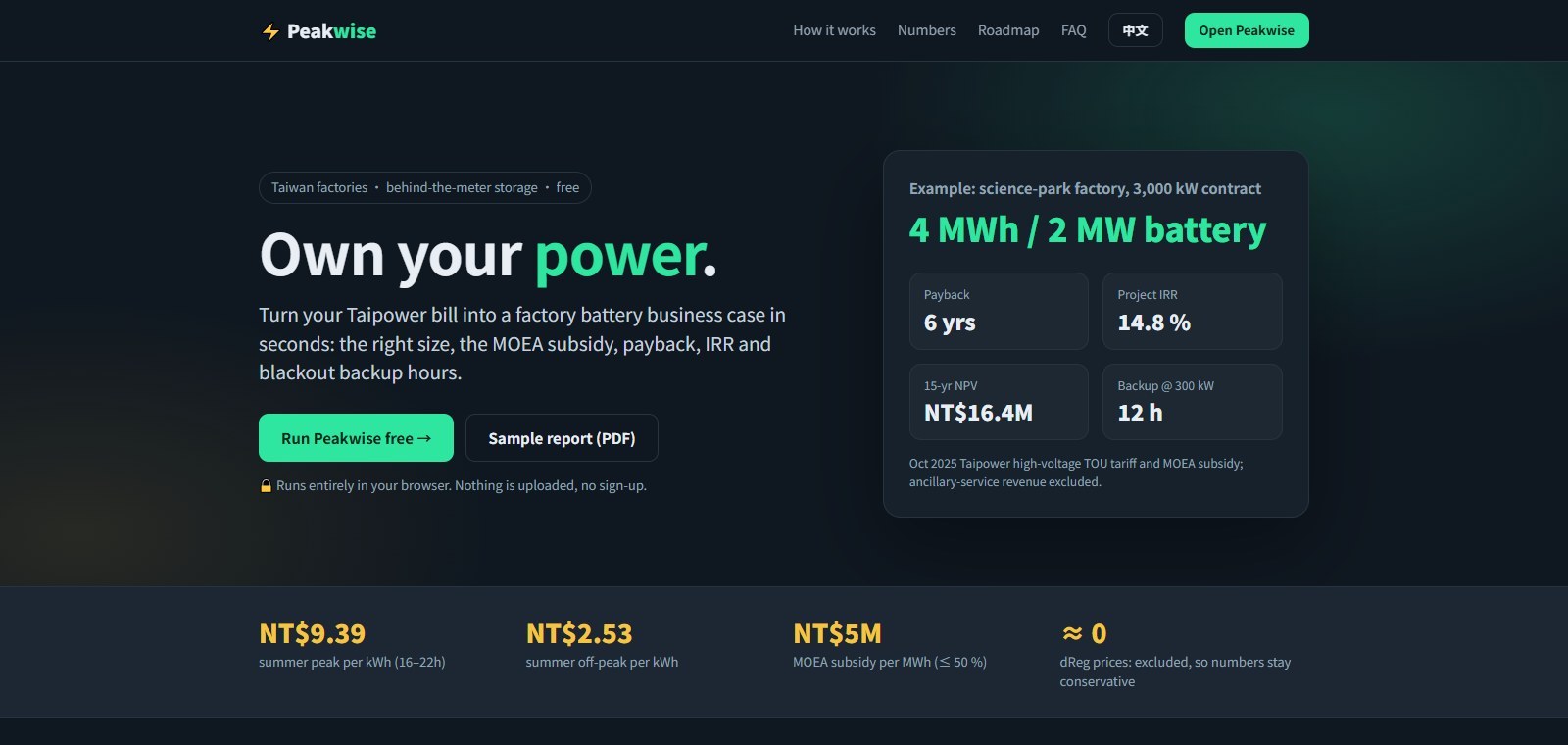
A free calculator that tells a Taiwan factory in 60 seconds whether on-site battery storage pays back, using the real Taipower tariff and the MOEA subsidy.
Taiwan just made peak electricity expensive.
Most factory owners never run the numbers because a consultant quote takes weeks.
One HTML file. Nothing to install, no sign-up, and your numbers never leave the page.
Taipower's October 2025 three-stage high-voltage tariff, MOEA storage subsidy and current BESS prices.
Shows the maximum fair price per kWh, so you know if an integrator's offer pays. We don't sell batteries.
Go to juw12.github.io/peakwise (中文 or English, auto-detected; switch any time).
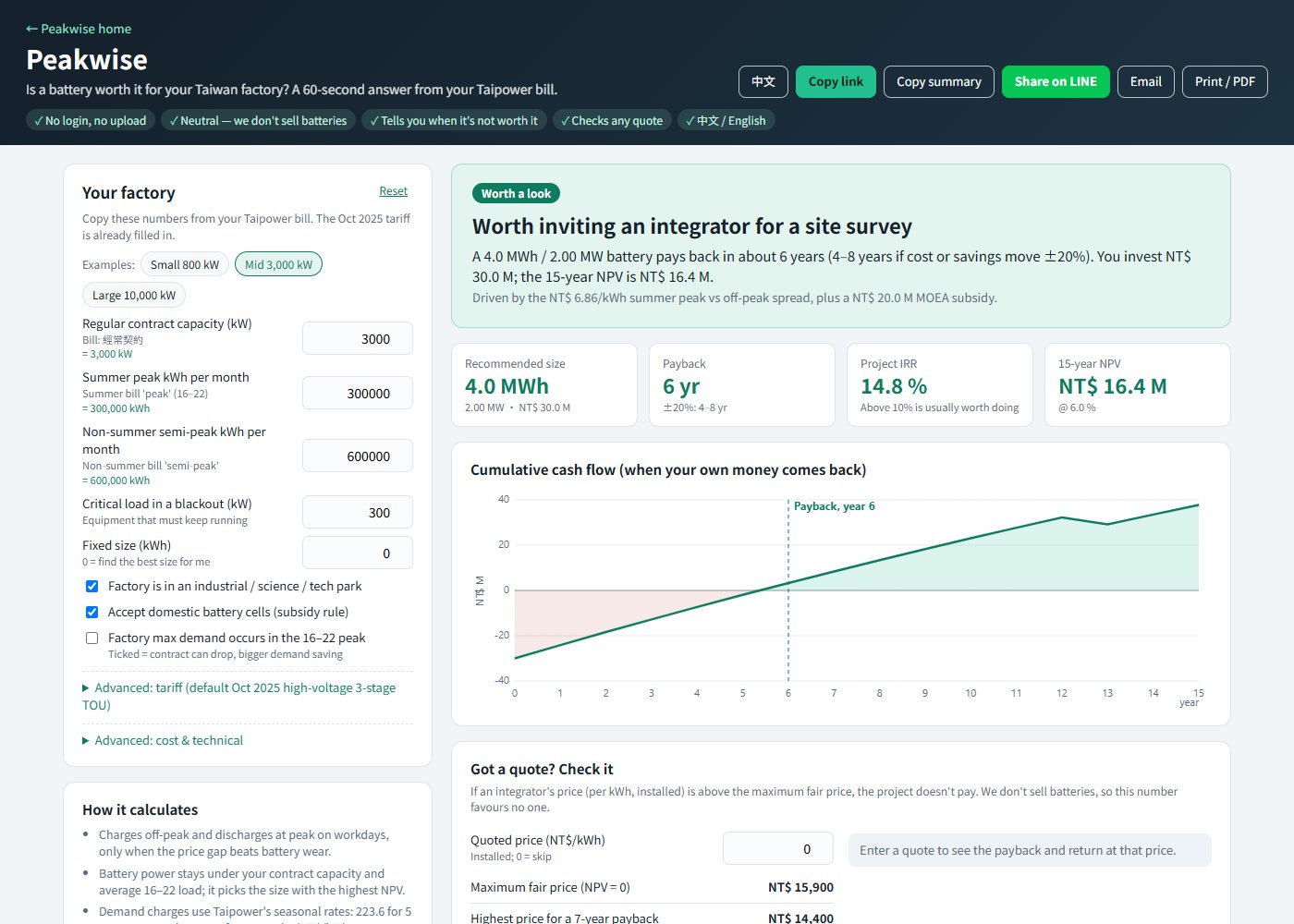
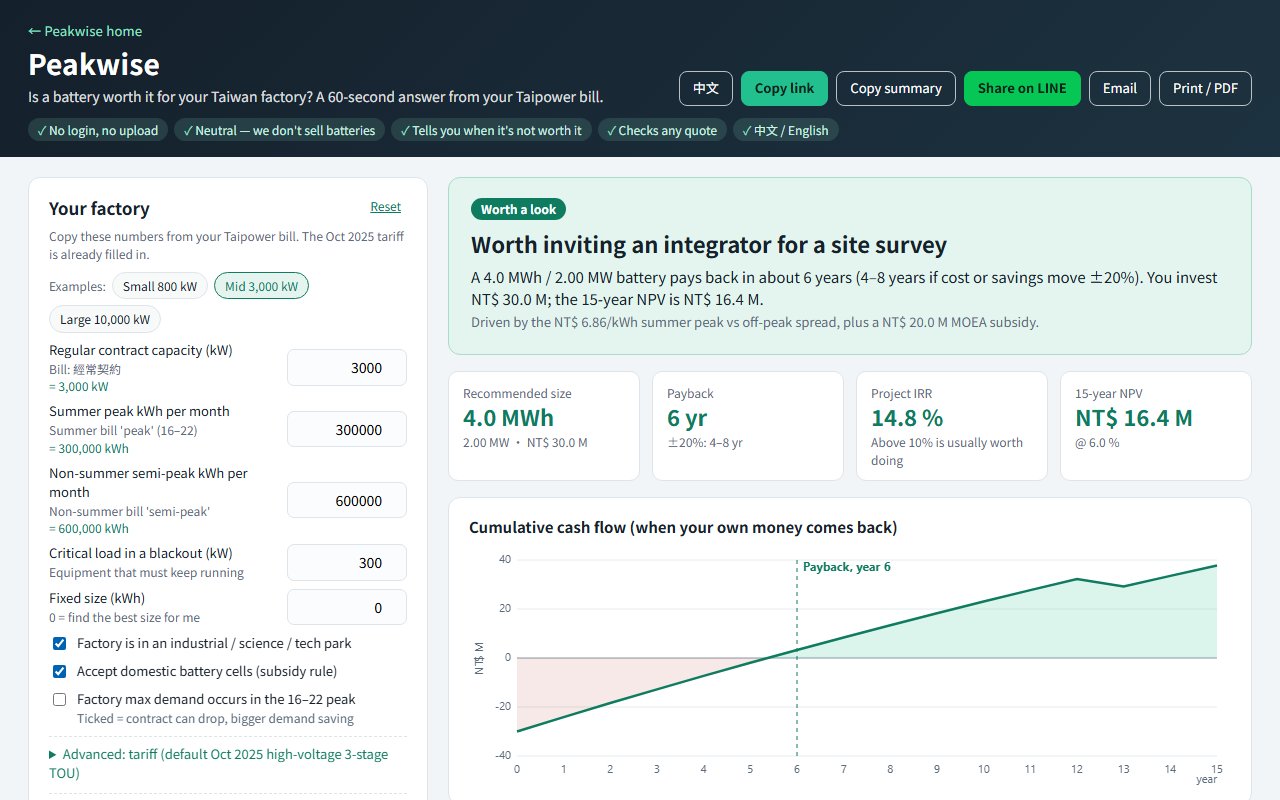
Click Open the calculator and enter your contract capacity, peak load, monthly kWh and working days.
Read the recommended size, payback, IRR and 15-year NPV, then Print / save PDF.
Uses the October 2025 three-stage high-voltage tariff: NT$9.39/kWh summer peak against NT$2.53/kWh off-peak.
Applies the storage subsidy of NT$5M/MWh (up to 50%, for 1–10 MWh systems).
Recommends a battery size and shows payback, IRR and 15-year NPV for it.
Re-runs the case with cost +20%, savings −20% and no subsidy, and says plainly when a battery is not worth it.
Shows the maximum fair price per kWh, so you know if an integrator's offer pays.
Gives a shareable link for your boss and a printable report (Print / save PDF).
Language is auto-detected and you can switch at any time.
The browser engine is checked against the Python reference model by the test suite.
From the README’s “Development” section. Full options, requirements and troubleshooting are there too.
Open the README$ python tests/test_model.py # model regression tests plus calculator parity check
$ python model/taiwan_pilot.py # full scenario table (JSON + chart in model/taiwan_pilot_output/)
# web: no build step; open the file directly, or serve docs/
$ python -m http.server 8000 -d docs # then visit http://localhost:8000/calculator/#selftestStraight from the README, so you know what you're getting before you try it.
12 files in the repo · last updated 6 Nov 2026.
Browse the codeCalculator: verdict right after inputs on phone/tablet, table scroll cue, even preset row, roomier Details labels (#2)
Design: fix mobile overflow, LINE contrast, tap targets, small text, calculator favicon (#1)
Move to juw12/peakwise: update all URLs
Battery Check: fix seasonal demand-charge rates, verdict, quote check, sensitivity, LINE share, presets
Watt Reserve: Taiwan factory battery-storage payback calculator
The commands in the “Development” box above come straight from the README. Paste them into a terminal; the README covers options and troubleshooting.
One HTML file. Nothing to install, no sign-up, and your numbers never leave the page. No login and no meter-data upload.
Any modern browser: it is one HTML file with nothing to install, and its maths is checked against a Python reference model.
In the README's reference case (a 2 MWh / 1 MW system on the October 2025 tariff with the MOEA subsidy) the battery pays back in 6 years with a 14.8% IRR and an NPV of +NT$8.2M, while the same system on the 2023 tariff without a subsidy never pays back.
The roadmap lists uploading a Taipower bill (PDF) to fill in the inputs, 15-minute load-profile import, a solar + storage case and an integrator directory.
This is a screening tool, not an engineering study. Taipower dReg ancillary-service revenue is excluded on purpose, because clearing prices are near zero after the market filled up.
Yes. The source is public on GitHub under the MIT licence.
Juwen Lie, an R&D mechanical engineer in Batam, Indonesia, as an independent personal project.
Own your power.